
If you’re staring at your mattress at 2 a.m. and wondering whether a hot room can kill bed bug eggs, the short answer is yes, heat can work. But here’s the thing: to kill bed bug eggs, the eggs themselves have to get hot enough for long enough, and a bedroom that simply feels miserable and stuffy is not the same as a successful treatment.
Can Heat Kill Bed Bug Eggs?
Yes, heat can kill bed bug eggs. That part is true.
The part that trips people up is how precise the process has to be. Bed bug eggs do not die just because the air in your room gets hot. The heat has to reach the actual hiding spot, inside seams, cracks, joints, baseboard gaps, and tucked-away corners, and stay there long enough to do the job. If that does not happen, eggs survive, hatch a few days later, and it looks like the treatment “almost worked.” Almost is not enough with bed bugs.
Why Bed Bug Eggs Are So Hard to Kill
Eggs are tougher than adult bed bugs and young bed bugs. That is the direct truth, and it matters because eggs are the stage most likely to survive a sloppy treatment.
A commonly cited threshold is that adults and nymphs die around 118°F, while eggs need about 122°F. That small gap sounds minor, but in real rooms it is a big deal. A treatment that is good enough for crawling bugs may still leave eggs behind.
The shell protects more than you’d expect
A bed bug egg is tiny, pale, and wrapped in a protective outer shell called a casing. In plain English, that shell acts like a little shield. It does not make eggs indestructible, but it does make them harder to kill with sprays, harder to dry out quickly, and harder to heat evenly.
That is why eggs often outlast the part of the infestation you can actually see. The moving bugs die first. The eggs are the stubborn leftovers.
Temperature alone is only half the story
Time matters just as much as temperature. Lower heat can work if it lasts much longer. Higher heat works faster.
Think of it like baking a casserole. Warming the kitchen does not cook the cold center. The center has to get hot too, and it has to stay hot long enough. Bed bug treatment works the same way. Research found that at 45°C, or 113°F, eggs could survive about seven hours, while at 48°C, or 118.4°F, the lethal time dropped to about 71.5 minutes. Small temperature jumps can change the outcome a lot.
What Bed Bug Eggs Look Like and Where You’ll Usually Find Them
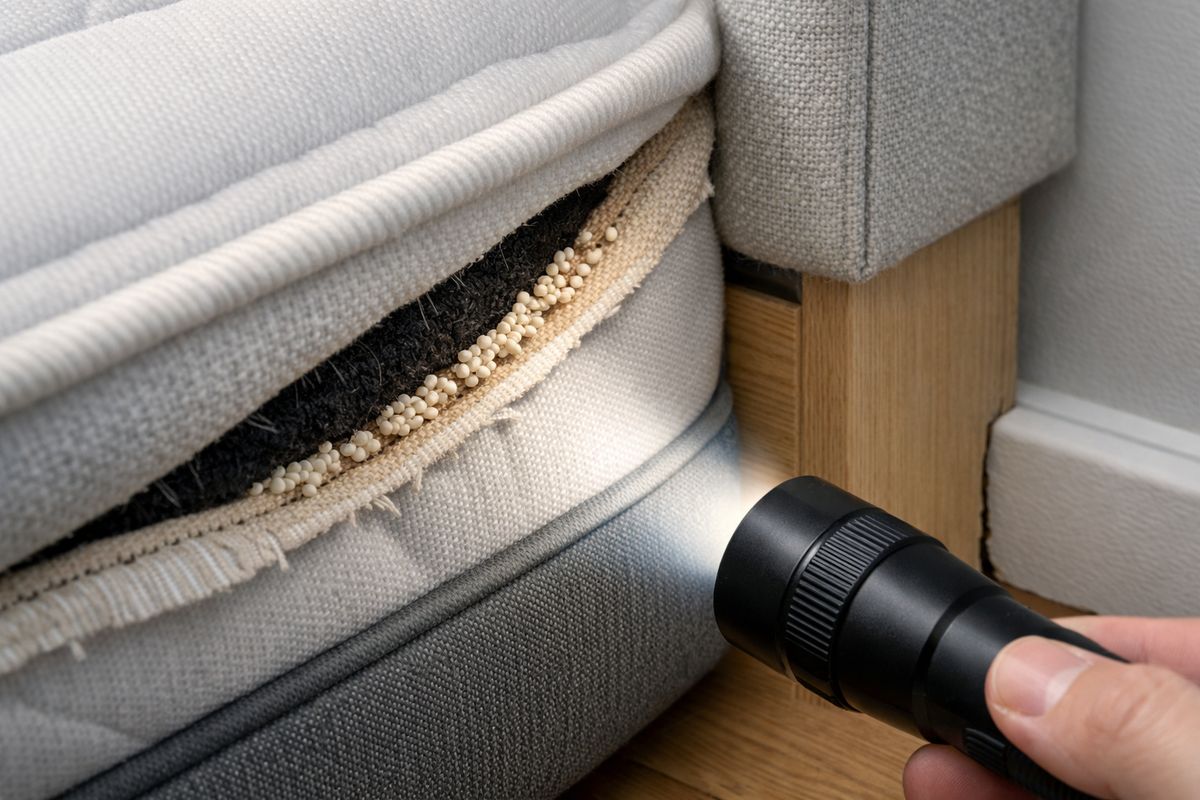
Bed bug eggs are tiny, about the size of a speck of dust or a grain of salt, though a little more elongated. Fresh eggs are usually pearly white to translucent. They can be easy to miss unless light hits them just right.
Another detail matters: eggs are sticky. Bed bugs glue them onto surfaces, which is why you may find them clinging to fabric seams, wood joints, or rough surfaces instead of rolling around loose.
Most eggs stay close to where you sleep or sit for long stretches. Bed bugs like predictable access to blood meals, so eggs usually show up near the bed, couch, recliner, or upholstered chair you use often.
Common hiding spots around your bed and furniture
Start with mattress seams, piping, tufts, and labels. Then check the box spring, headboard, bed frame joints, screw holes, slats, and the cracks in nearby nightstands. If your bed sits near a wall, pay attention to baseboards, especially behind the head of the bed. One very real hiding spot is behind a slightly loose baseboard right where the carpet edge meets the wall.
Upholstered furniture can hold eggs too, especially under cushions, beneath dust covers, and along stapled fabric edges. Drawers are another common miss. Not just inside them, but under them and along the back corners.
If you are still trying to confirm what you are seeing, it helps to compare your findings with other warning clues around the room before assuming every pale speck is an egg.
How long eggs take to hatch
Bed bug eggs often hatch in about 6 to 10 days, though room conditions can shift that a bit. That timeline explains why an infestation can seem gone right after treatment and then start up again a week later.
This is one reason people feel like they are losing their minds. You clean, treat, sleep better for three nights, then suddenly notice fresh activity. Surviving eggs are often the reason.
What Counts as “Enough Heat” to Kill Bed Bug Eggs
“Enough heat” does not mean the thermostat reading, the heater setting, or how hot the room feels when you walk in. It means the coldest hiding places reached lethal temperatures for long enough.
The EPA says infested items or areas should reach at least 120°F for 90 minutes to ensure eggs are killed. In real-world structural treatments, companies often run hotter and longer than that because rooms are uneven, furniture traps cool pockets, and hidden spaces heat slowly.
The key numbers to know
A few numbers help this make sense. Eggs are often cited at around 122°F for kill thresholds. The EPA uses 120°F for 90 minutes as a practical benchmark for infested articles or areas. Field guidance also shows how time stretches as temperature drops: 120°F for 8 hours, 125°F for 6 hours, 130°F for 4 hours, 135°F for 3 hours, and 140°F for 2 hours.
That does not mean every treatment has to match those exact numbers. It means there is no shortcut around the same principle: lower heat needs more time, and hidden spots need both.
Why room temperature readings can fool you
This is where treatments fail. Air temperature in the center of a room can look great while the bugs hiding under a baseboard or inside a bed-frame joint are still sitting in a cooler pocket.
One field example is especially striking: a room measured 134.6°F, but a probe under a baseboard showed only 102.2°F. That is the difference between a treatment that sounds impressive and one that actually kills eggs.
Does DIY Heat Work, or Do You Need Professional Treatment?
DIY heat can work for small, contained items. Whole-room or whole-home heat is where DIY usually falls apart.
That is not because you are doing something wrong. It is because bed bugs hide in places household heat does not reach evenly. Thick furniture, wall edges, clutter piles, electronics, books, and deep crevices create cold spots fast. If you are comparing options, it helps to understand how different treatment approaches stack up before sinking money into the wrong one.
What you can safely heat at home
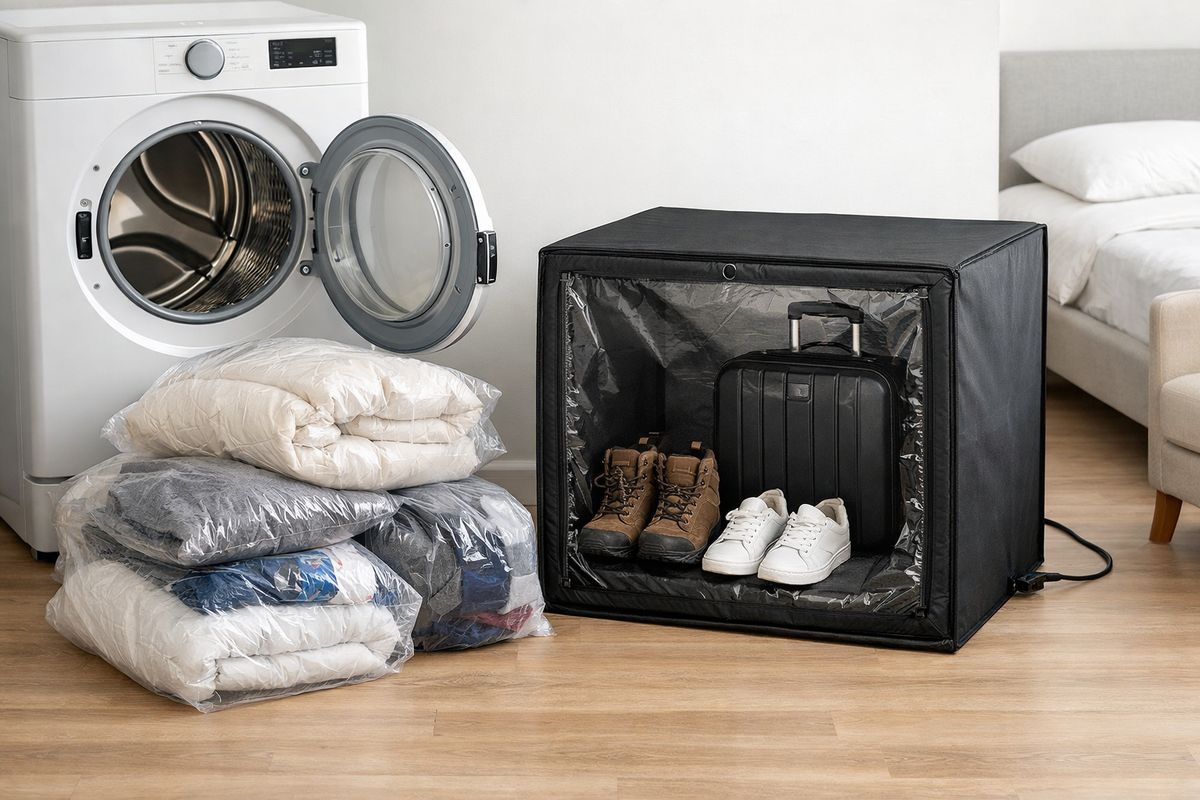
Clothing, sheets, pillowcases, blankets, and many washable fabrics can often be treated at home. The dryer is one of the most useful tools you have. The EPA says a high-temperature dryer cycle for 30 minutes can kill bed bugs and eggs on many fabrics. Washing helps clean items, but the drying step is usually what does the killing.
Portable heating enclosures designed for infested items can also be useful for shoes, luggage, and certain household goods. Sealed bags matter too. If you move infested laundry through the house in an open basket, you risk spreading the problem before treatment even starts.
A hair dryer will not fix this. A space heater will not fix this. Cranking up your home thermostat will definitely not fix this.
Where DIY heat usually fails
DIY heat usually fails in hidden areas, not obvious ones. A mattress surface may get hot while the wooden frame joint underneath stays too cool. A closet may feel warm while the clutter piled in the corner acts like insulation. A couch arm may heat up while eggs tucked beneath the stapled underside stay protected.
The phrase “the room felt like an oven” means almost nothing. Bed bug eggs do not care how uncomfortable the room feels. They care what temperature reached the exact place they are glued to.
What professional heat treatment should include
A solid professional job includes more than blasting hot air. It should involve multiple heaters or smart heater placement, strong fans for circulation, temperature probes in hard-to-heat spots, enough hold time at target temperatures, and clear instructions for prep and follow-up.
You should also expect a company to talk plainly about monitoring, not just promise that the room gets “super hot.” If you want a deeper breakdown of what a properly planned whole-room heat service looks like, that is worth reviewing before you book anything.
Questions to Ask Before You Pay for a Heat Treatment
Bed bug treatment is expensive enough without paying for a flashy failure. A few pointed questions can save you a lot of money and stress.
How will temperatures be monitored?
Ask where probes will go. Not just in the middle of the room, but near baseboards, furniture seams, bed-frame joints, and wall-adjacent areas where bed bugs actually hide.
Virginia Tech specifically warns that room temperature alone is not reliable, and technicians need to measure hard-to-heat locations such as floor-wall junctions and spaces under baseboards. Ask whether you will get documentation showing what temperatures those spots reached.
Is this heat-only, or part of a bigger plan?
Heat is powerful, but a bigger plan is better. The EPA recommends an integrated approach that combines heat with monitoring, encasements, inspection, and targeted treatments when needed.
That matters because surviving eggs or hidden bugs can restart the infestation. If a company sells heat as a magic one-step cure with no follow-up, be careful. It is smarter to choose somebody who also talks about inspection and what happens if activity continues. That is especially true if you are already at the point of deciding when professional help makes sense.
What prep and follow-up are required?
Ask what you need to move, bag, wash, dry, declutter, or protect before treatment. Ask which heat-sensitive items must come out. Ask what follow-up happens if you still see signs afterward.
A good company should have a clear prep process, not vague advice to “clean up a little.” If you want a room-by-room guide before treatment day, this walkthrough on getting your home ready without missing the obvious stuff helps keep prep from becoming guesswork.
What Heat Will Not Do on Its Own
Heat has a real place in bed bug control. It is not magic.
If the infestation has spread to multiple rooms, nearby apartments, or hidden voids, heat alone may not solve everything in one pass. You still need inspection and confirmation afterward.
Heat will not reach every spot by accident
Closed drawers, stuffed closets, thick stacks of belongings, piled bedding, and insulated cracks can all stay cooler than the rest of the room. That is why technicians reposition fans, shift contents, and keep checking temperatures during treatment.
Even a long treatment can miss protected pockets if the setup is poor.
Heat will not prevent reintroduction
A successful treatment kills the bugs and eggs currently there. It does not stop new bed bugs from arriving later on luggage, used furniture, guests’ belongings, or neighboring units in a shared building.
That is frustrating, but it is better to know it upfront than assume treatment creates some kind of lasting shield.
Heat will not replace inspection
You still need to know where bed bugs were hiding and whether any remain. Inspection is how you confirm success. Without it, you are guessing.
That is why interceptor traps, encasements, and follow-up checks matter after treatment. Peace of mind is nice. Proof is better.
Other Ways to Kill or Remove Bed Bug Eggs
Heat gets most of the attention, but it is not the only tool.
Washing, drying, steaming, and vacuuming
Drying is one of the best at-home options for fabrics. Hot washing can help, but washing alone is less reliable than drying on high heat. Steam can also kill eggs when used slowly and correctly on seams, edges, cracks, and furniture corners. The catch is that steam is easy to misuse. Too fast, and surfaces do not get hot enough. Too forceful, and bugs scatter deeper into hiding.
Vacuuming helps remove bugs and eggs, especially from seams and crevices, but it is incomplete. It is more of a reduction tool than a full solution. You still need to empty the vacuum carefully and contain the contents right away.
Encasements and isolation steps
Mattress and box spring encasements make a real difference. They do not kill every egg in the room, but they reduce hiding places and trap bugs already inside so those bugs cannot keep feeding.
Isolation steps matter too. Bagging infested linens before moving them, containing suspect items, and reducing clutter all make eggs harder to spread and easier to target.
When pesticides come into the picture
Many sprays do not kill eggs well, and resistance is common. That is why pesticides should be treated as one part of a larger plan, not the entire plan.
Sometimes targeted products, including dusts in the right places, are useful after heat treatment to catch survivors. But if somebody sells you a single spray bottle as the answer to bed bug eggs, that is not a real answer.
Signs the Treatment Worked , or Didn’t
Success is measured over time, not by how relieved you feel the same day.
Good signs after treatment
A good result usually looks boring, and that is exactly what you want. Fewer or no live bugs. No fresh dark fecal spotting near the bed. No new cast skins. Monitors and interceptors staying clear over the following weeks.
You may still feel jumpy for a while. That part is normal. What matters is whether actual signs keep showing up.
Red flags that eggs may have survived
Fresh tiny nymphs appearing days later is a major warning sign. So is new spotting near the same side of the bed, or activity concentrated in one corner of the room that seems to have “woken back up.”
The EPA notes that treatment may need repeating because eggs can survive the first round, especially if some areas were missed. If you still have activity after treatment, look for a pattern. One stubborn area often points to an untreated harborage.
The Short Answer for Your Home
Yes, heat can kill bed bug eggs, but only when the eggs themselves reach the right temperature for long enough in the places where they are actually hiding. That is the whole story in one sentence.
If you do one useful thing this week, inspect three spots before paying for any treatment: your mattress seams, your bed-frame joints, and the baseboard behind the head of the bed. If you are weighing professional options, this page on heat treatment for bed bugs gives a practical look at what a service should actually accomplish.
Frequently Asked Questions
Can sunlight or a hot car kill bed bug eggs?
Sometimes, but it is not reliable enough to trust. Cars and sun-heated rooms warm unevenly, and bed bug eggs survive in cooler protected spots. Unless you can verify temperatures in the actual hiding places for long enough, it is a gamble.
Does washing bedding kill bed bug eggs?
Not by itself in every case. The safer bet is the dryer. High-heat drying is much more dependable for killing eggs and bugs in washable fabrics than washing alone.
Can a steam cleaner kill bed bug eggs?
Yes, steam can kill eggs if it reaches them directly and is used slowly enough on seams, cracks, and fabric edges. It is still a spot treatment, not a full-room solution, and some surfaces should not be steamed.
Why do bed bugs come back after heat treatment?
Usually because some eggs or hidden bugs survived in a cooler pocket, or because bed bugs were reintroduced later. That is why follow-up inspection matters so much after heat treatment.
Is one heat treatment always enough?
No. One good treatment can solve the problem, but not always. If hidden harborages stayed too cool, eggs can hatch later and restart the infestation. That is why monitoring for a few weeks matters.
Can sprays kill bed bug eggs as well as heat?
Usually not. Many sprays are weak against eggs, and resistance is a real issue with bed bugs. Heat, drying, steam, vacuuming, encasements, and follow-up inspection usually need to work together for the best chance of success.